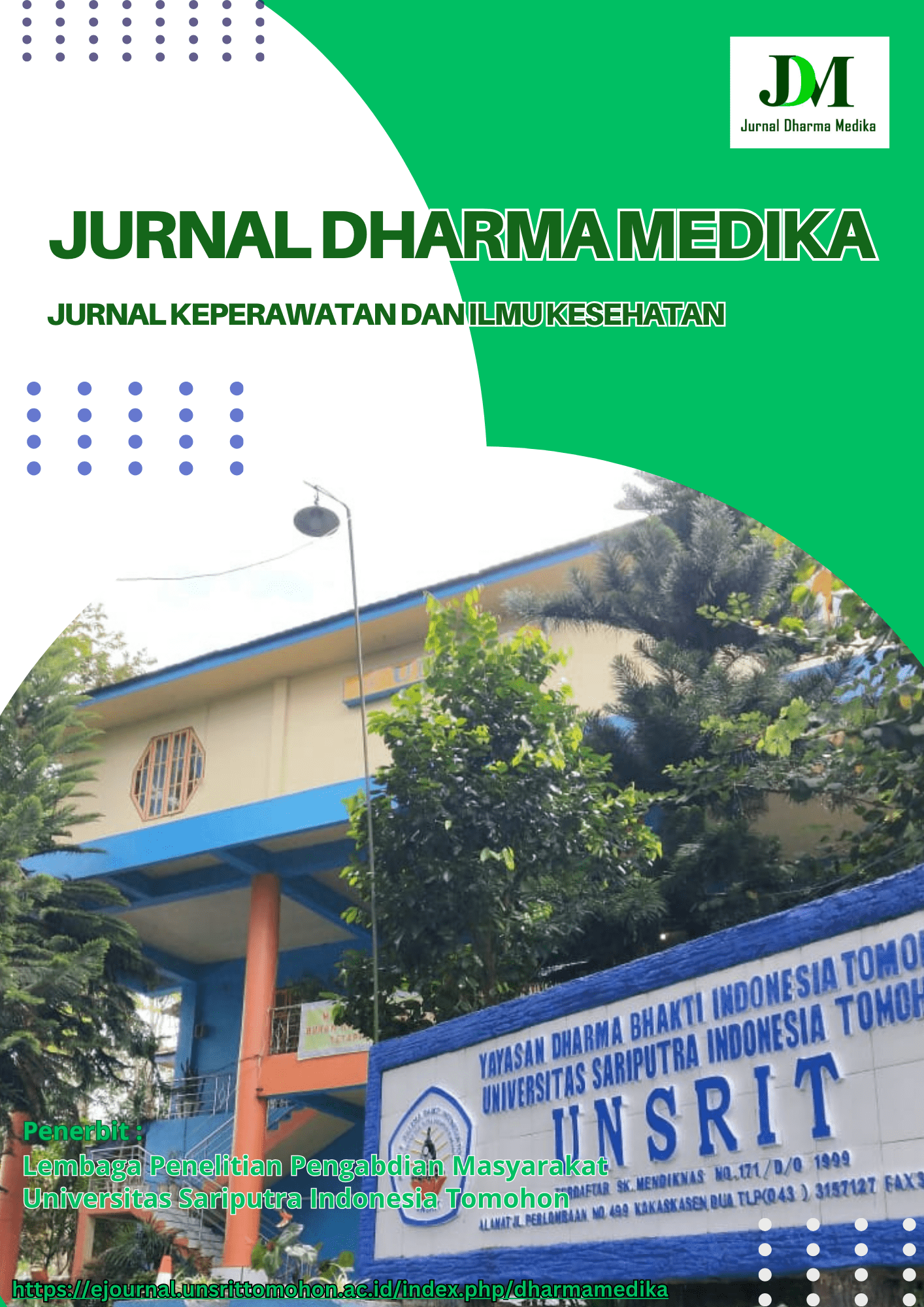
The Relationship Between Maternal Knowledge and Complementary Food Provision and the Incidence of Diarrhea in Infants at the Kakaskasen Community Health Center
DOI:
https://doi.org/10.70524/zn6hbr34Keywords:
Maternal knowledge; Provision of complementary feeding; Incidence of diarrhea; in infantsAbstract
Diarrhea is a common health problem experienced by infants and can be influenced by various factors, including maternal knowledge and the practice of providing complementary foods (MP-ASI). This study aims to determine the relationship between maternal knowledge and the provision of MP-ASI with the incidence of diarrhea in infants in the working area of the Kakaskasen Community Health Center in December 2024–January 2025. The study used a quantitative method with a chi-square test. The results showed a significant relationship between the provision of MP-ASI and the incidence of diarrhea (ρ = 0.001; p < 0.05). A total of 62% of mothers had good knowledge, while 38% had poor. The analysis showed a significant relationship between maternal knowledge and the incidence of diarrhea (ρ = 0.014; p < 0.05). It was concluded that good maternal knowledge and appropriate practices of providing MP-ASI play an important role in reducing the risk of diarrhea in infants. Continuous education regarding nutrition and early detection of diarrhea symptoms are needed to support infant health.Downloads
Download data is not yet available.
Downloads
Published
2025-12-31
Issue
Section
Articles
License
Copyright (c) 2025 Enita Elhud, Ns. Irwan E Walanda, S.Kep., M.Kep, Anggela Adam (Author); Jetty Mongdong, Sendy J.Owu (Translator)

This work is licensed under a Creative Commons Attribution 4.0 International License.
Copyright Notice EditEdit Copyright Notice

Dharma Medika Journals is licensed under ahttps://creativecommons.org/licenses/by-sa/4.0/
You are free to:
- Share — copy and redistribute the material in any medium or format for any purpose, even commercially.
- Adapt — remix, transform, and build upon the material for any purpose, even commercially.
- The licensor cannot revoke these freedoms as long as you follow the license terms.
Under the following terms:
- Attribution — You must give appropriate credit , provide a link to the license, and indicate if changes were made . You may do so in any reasonable manner, but not in any way that suggests the licensor endorses you or your use.
- ShareAlike — If you remix, transform, or build upon the material, you must distribute your contributions under the same license as the original.
- No additional restrictions — You may not apply legal terms or technological measures that legally restrict others from doing anything the license permits.
Notices:
You do not have to comply with the license for elements of the material in the public domain or where your use is permitted by an applicable exception or limitation .
No warranties are given. The license may not give you all of the permissions necessary for your intended use. For example, other rights such as publicity, privacy, or moral rights may limit how you use the material.
How to Cite
The Relationship Between Maternal Knowledge and Complementary Food Provision and the Incidence of Diarrhea in Infants at the Kakaskasen Community Health Center. (2025). DHARMA MEDIKA, 5(2), 52-61. https://doi.org/10.70524/zn6hbr34